
The Columbia University Individual Development Plan (IDP) Program is designed to help participants recognize the importance of managing one’s own career, develop strategies to help with career management, and comprehend the purpose and value of an IDP. Through involvement in the IDP Program, participants will also be able to develop skills relevant to a variety of careers.
This program—which is collaboratively organized by Columbia Engineering, the Coordinated Doctoral Programs in Biomedical Sciences at the Vagelos College of Physicians and Surgeons, the Graduate School of Arts and Sciences, and the Office for Postdoctoral Affairs and Early Career Research—is open to PhD students and Postdoctoral researchers, scholars, and scientists in all academic disciplines at Columbia University.
Overall topics and goals of the Columbia IDP Program:
- Identify skills, interests, and values
- Identify potential career options
- Devise strategies for managing their careers
- Independently complete an IDP through myIDP (STEM), ImaginePhD (Humanities and Social Sciences), or ChemIDP (Chemical Scientists)
- Utilize their IDP to share short- and long-term career development plans with their Principal Investigator (PI), Faculty Adviser, or Mentor
- Develop skills for a variety of career paths
- Engage in networking opportunities to learn more about numerous career paths
Important information about participating in the Columbia IDP Program:
- You do not have to attend each session to participate in this program or to receive a Certificate of Completion.
- Each session is open to all Columbia University graduate students and Postdoctoral researchers, scholars, and scientists.
- Please check with your PI, Faculty Adviser, Mentor, or Director of Financial Aid to determine if your NSF or NIH funding requires you to file an IDP annually.
Creating an IDP:
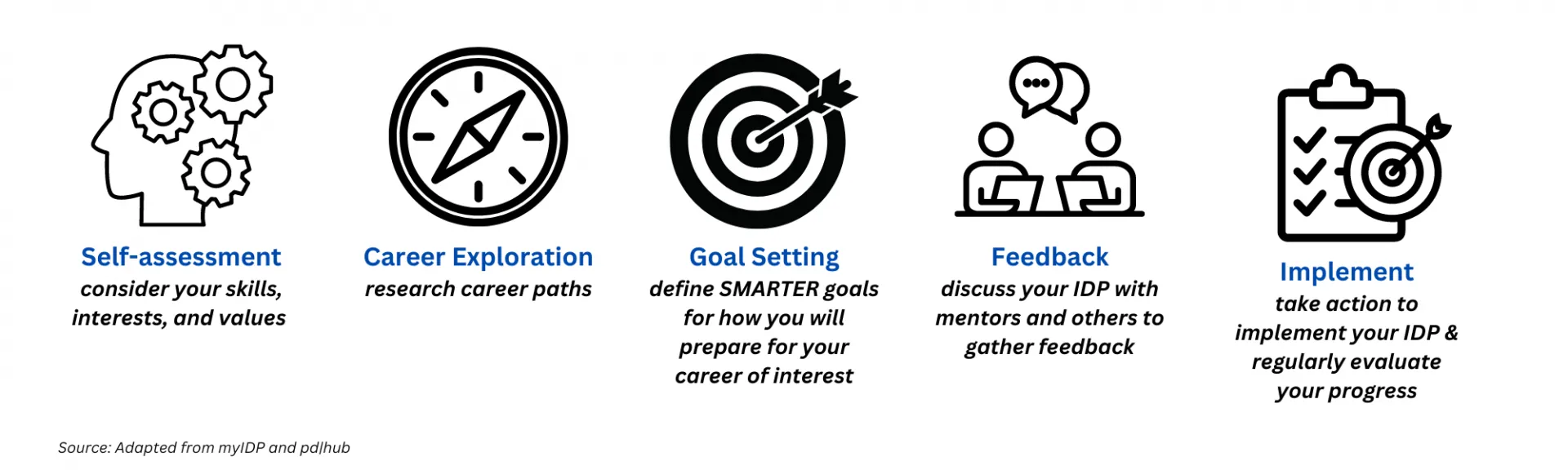
An IDP is a document that allows you to identify your skills, interests, and values; research possible career paths; and create goals that help you achieve your future career plans. The process for creating an IDP can be broken down into the following steps:
Certificate of Completion:
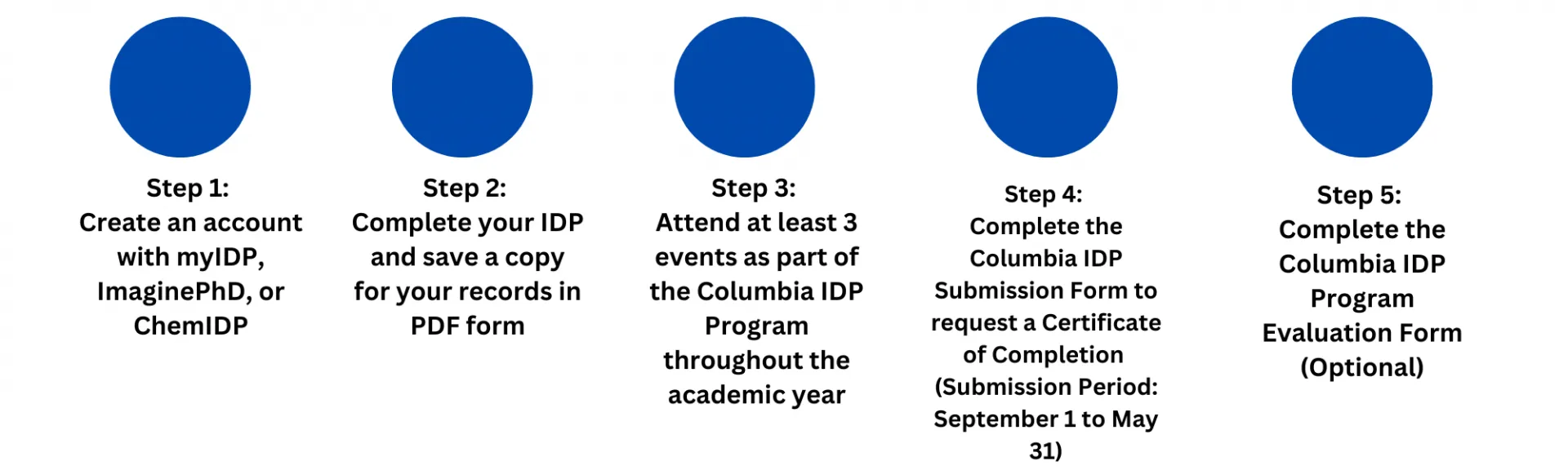
Please follow these steps to obtain a Certificate of Completion for participating in the Columbia IDP Program. Submission Period: September 1 – May 31.
Upcoming IDP Events
Resources
About the Columbia IDP Program
To develop your IDP, please visit myIDP (STEM), ImaginePhD (Humanities and Social Sciences), or ChemIDP (Chemical Scientists) to complete a free registration. Upon registration, you will be able to complete your IDP following the instructions provided. You may also use the worksheets on this website under "Columbia IDP Program Calendar and Educational Resources" as supplemental materials to help you create an IDP.
The following online sources can help you explore different career paths:
- Science Careers: STEM-focused blogs
- Beyond the Professoriate: Focuses on non-faculty careers (choose "Columbia University - Postdocs" and log in using your UNI credentials)
If you would like to participate in the Columbia IDP Program to receive a Certificate of Completion, please make sure to complete the following steps. Note: It is not required to do this in order to attend the workshops affiliated with the IDP program.
- Once you have developed your IDP, please print or save a copy of the completed IDP. (The Print option on your web browser may allow you to save your IDP as a PDF.)
- Using information from your completed IDP, answer the Columbia IDP Submission Form. This form will not be shared with your PI or Faculty Adviser (unless you specifically request this).
- Attend at least three IDP seminars, workshops, or networking panels throughout the academic year.
Please consider sharing feedback about your experience in the program by completing the Columbia IDP Program Evaluation Form. The evaluation is strictly anonymous and will be used to assist in understanding the effectiveness of the Columbia IDP Program, and the career and professional development needs of graduate students and Postdocs at Columbia University.
2025-2026 IDP Program Summary
This program is organized by Columbia Engineering, the Coordinated Doctoral Programs in Biomedical Sciences at the Vagelos College of Physicians and Surgeons, the Graduate School of Arts and Sciences, and the Office for Postdoctoral Affairs and Early Career Research.
September 12, 2025: Developing an Individual Development Plan
Career preparation in STEM, Humanities, and Social Sciences often requires thoughtful exploration, intentional planning, and building connections that support your professional goals. An Individual Development Plan (IDP) is a valuable tool to help you assess your values, skills, interests, and long-term objectives. This presentation will guide participants in creating an IDP tailored to their academic background and career aspirations—whether in research, teaching, industry, policy, or beyond.
Presenter: Office for Postdoctoral Affairs and Early Career Research (OPA)
September 15, 2025: Thriving, Not Surviving: Time Management and Wellness for PhDs
This interactive workshop is designed to help attendees strengthen their time management skills while maintaining personal well-being. Participants will explore evidence-based strategies to effectively prioritize tasks, set achievable goals, and navigate the demands of academic and career planning. The session will also introduce mindfulness practices and stress-reduction tools to support mental health and prevent burnout. Attendees will leave with practical techniques to boost productivity and cultivate a healthier work-life balance.
Speaker:
- Anna Womack, PhD, Licensed Psychologist
October 1, 2025: How to Approach and Connect with Industry Professionals
This session offers an overview of informational interviewing and its vital role in the career planning and exploration process. participants will learn how to identify and reach out to potential contacts, structure effective conversations, and ask insightful questions to gather meaningful career insights. The session will also address key social norms and strategies for making informational interviews relationship-focused rather than transactional. Additionally, it will provide guidance on how to follow up and maintain connections to support ongoing professional growth.
Speaker:
- Lauren Celano, Co-Founder of Propel Careers
October 3, 2025: Presentation Skills for Scholars: Clarity, Confidence & Connection
This is an in-person, 90-minute workshop for graduate students and postdocs on how to give an effective class presentation, defend a thesis, or present a research project.
As they prepare for these common speaking scenarios, scholars—who are understandably focused on content—often neglect to work on the organization and delivery of their talks. To counter that tendency, this interactive workshop will show participants how to:
- structure their points in a clear and accessible way;
- discuss the value of their work;
- speak with relaxed confidence;
- practice answering (sometimes uncomfortable) questions; and
- build rapport with listeners.
Attendees will leave this workshop with a roadmap for how to develop a successful, professional presentation, and with actionable tips and insights that they can put to immediate use.
Speaker:
- Jezra Kaye, Author and Public Speaking Coach
October 21, 2025: Telling Your Story: Stand Out in Career Conversations
In this engaging workshop, participants will learn how to use storytelling as a powerful tool for networking and interviewing. Through guided exercises and active listening, you will craft a clear and compelling narrative that communicates your strengths, skills, values and professional journey. Whether you're preparing for informational interviews, job interviews, or professional networking events, this session will help you articulate your story in ways that resonate with diverse audiences and career paths. This workshop has been adapted from materials in the Professional Development Hub (pd|hub) Collections, developed with funding from the NIH.
Facilitator:
- Francesca Fanelli, Senior Associate Director, GSAS Compass
October 24, 2025: Working with Workplace Communication Styles
Effective communication is essential for building trust, providing feedback, and fostering collaboration in mentoring and team-based environments. This workshop introduces an established framework to help participants understand their own and others' communication styles and how they impact team dynamics and mentoring relationships. Participants will also explore assertive communication techniques that promote open dialogue, mutual respect, and productive conflict resolution. Through practical exercises and discussion, attendees will gain tools to enhance clarity, adapt their communication to different personalities, and strengthen their effectiveness as mentors, mentees, and team members.
Speaker:
- Robert E. Tillman, PhD, Associate Vice Dean and Director of Mentoring and Advancement at the Vagelos Institute at Columbia
November 18, 2025: Giving and Receiving Feedback in the Research Environment
Feedback is a crucial skill for academic and professional growth. In this interactive workshop, we will explore effective strategies for giving and receiving feedback. Whether you’re a Postdoc or a PhD student, mastering this skill is essential for success in research, teaching, and collaboration.
Facilitators:
- Spencer Bennett, MEd, SHRM-CP, Director of Compliance and Training, CUIMC
- Kenneth Prager, MD, Professor of Medicine, Department of Medicine, CUIMC
December 2, 2025: Navigating Interpersonal Conflict on Your Research Team
Conflict is a frequent part of collaboration within research teams. How leaders and team members manage conflict significantly impacts relationships, decision-making, and overall team effectiveness. In this 1-hour workshop, we explore strategies for handling conflict using real-world case studies. By understanding the cooperative or competitive nature of conflict, participants will learn constructive approaches to address disagreements and foster productive collaboration.
Facilitators:
- Spencer Bennett, MEd, SHRM-CP, Director of Compliance and Training, CUIMC
- Kenneth Prager, MD, Professor of Medicine, Department of Medicine, CUIMC
February 3, 2026: Everything You Wanted to Know About Academic Book Publishing
Are you interested in learning about how to publish your research as a monograph? Join this conversation with two commissioning editors from Palgrave Macmillan who will discuss the process of publishing an academic book in the humanities and social sciences and turning a dissertation into a monograph. A moderated discussion will be followed by Q&A and networking with light refreshments. Come prepared with questions or concerns!
Speakers:
- Carly Silver, Commissioning Editor for History
- Christian Pizarro Winting, Editor for US Politics & Political Theory
February 18, 2026: Navigating a Career Beyond the Postdoc: Medical Science Liaison Path
Join us for a candid conversation with Dr. Regina Martuscello, a former Columbia University postdoctoral researcher, who transitioned into a Medical Science Liasion (MSL) role. Dr. Martuscello will share how she made the decision to move beyond academic research, the skills and experiences from her postdoc that now shape her work as an MSL, and what the career transition process looked like in practice. She will also offer practical advice for postdocs and graduate students considering an MSL career, including what to evaluate, how to prepare, and common misconceptions about the role.
Speaker:
- Regina Martuscello, PhD, Medical Science Liaison
March 10, 2026: Designing Dynamic Global Careers as an International Scholar
Building a career as an international postdoc or PhD student involves unique challenges that can limit your vision of what's possible. This seminar by Dr. Sonali Majumdar, based on insights from her book Thriving As An International Scientist, will help you reframe limitations into possibilities and design dynamic paths for fulfilling careers. You’ll discover creative frameworks, confidence-building tools, and practical strategies for long-term success in diverse careers—within and beyond the United States.
Speaker:
Sonali Majumdar, PhD, Assistant Dean for Professional Development in the Graduate School of Princeton University
2024-2025 IDP Program Summary
This program is organized by Columbia Engineering, the Coordinated Doctoral Programs in Biomedical Sciences at the Vagelos College of Physicians and Surgeons, the Graduate School of Arts and Sciences, and the Office for Postdoctoral Affairs and Early Career Research.
September 23, 2024: Developing an Individual Development Plan (Humanities & Social Sciences)
Career preparation in the Humanities and Social Sciences fields may require exploration, planning, and building the connections that will help you attain your goals. An IDP is a tool that can help you assess your values, skills, interests, and goals. This presentation aims to help participants develop an effective IDP tailored to their academic and career goals.
Presenter: Office for Postdoctoral Affairs and Early Career Research (OPA)
September 25, 2024: Developing an Individual Development Plan (STEM)
Career preparation in STEM fields may require exploration, planning, and building the connections that will help you attain your goals. An IDP is a tool that can help you assess your values, skills, interests, and goals. This presentation aims to help participants develop an effective IDP tailored to their academic and career goals.
Presenter: Office for Postdoctoral Affairs and Early Career Research (OPA)
October 8 & 10, 2024: Using Storytelling for Career Exploration and Self-Reflection
In this engaging workshop, we will practice storytelling as a tool for self-discovery and career exploration. Through guided exercises and active listening, you will create a compelling narrative of your personal and professional journey that highlights your skills, strengths, values, and achievements as you craft job applications and prepare for interviews in a variety of career paths.
This workshop has been adapted from materials of the Professional Development Hub (pd|hub) Collections, which were developed with funding from the NIH. The original workshop was developed by Urmila Venkatesh at Stanford University.
Facilitators:
- Office for Postdoctoral Affairs and Early Career Research (OPA)
- Francesca Fanelli, Senior Associate Director of Graduate Career Development, School of Arts & Sciences
October 22 & 24, 2024: American Business Culture and Communication
Although the U.S. is a relatively young country, the specifics of our business culture are well-established, and differ in significant ways from academic best practices. The goal of this workshop is to help you understand and adapt to U.S. business environments, particularly if you are considering a transition from academia to industry.
You'll learn how to:
- Identify and respond to common U.S. business values, expectations, and cultural practices;
- Connect, communicate, and establish productive relationships with colleagues, clients, senior leaders, and direct reports;
- Avoid awkward and compromising situations; and
- Successfully manage both collaboration and conflict at work.
All participants will receive a PDF of the workshop slides and extensive follow-up materials to deepen and reinforce their learning.
Speaker: Jezra Kaye, acclaimed speaker coach, speechwriter, and President of Speak Up for Success
October 29 & 31, 2024: Public Speaking Skills and Techniques
The ability to "stand and deliver" in a relaxed but authoritative way is critically important for success in every American industry. This workshop includes an overview of what public speaking is and how to master it, along with hands-on exercises for developing the requisite skills.
You'll learn how to:
- Organize your thoughts, quickly and concisely;
- Speak with confidence and clarity;
- Handle Q&A, including tough questions; and
- Practice for continual improvement in just one minute a day.
All participants will receive a PDF of the workshop slides and extensive follow-up materials to deepen and reinforce their learning.
Speaker: Jezra Kaye, acclaimed speaker coach, speechwriter, and President of Speak Up for Success
November 12, 2024: Effective Communication and Pronunciation in Cross-Cultural Settings
This intensive workshop is designed to assist participants who identify as non-native English speakers in navigating and effectively communicating in the global, cross-cultural research setting. Guided by the National Postdoctoral Association (NPA) Core Competency #3 Communication, this workshop has a focus on strategies for effective cross-cultural communication and clear pronunciation. Additionally, as English is typically the primary language of academic communication, participants will have the opportunity to explore principles of clear pronunciation and engage in practice pronunciation activities.
Participants will leave with a:
- diagram of their own cultural iceberg for future reference
- heightened awareness of personal communication styles and how these impact the workplace
- framework for anticipating and preparing for challenging conversations in cross-cultural settings (i.e., requests, negotiations, conflicts)
- toolbox of strategies and resources for continued self-development
Facilitator: Mallory Fix-Lopez, Founder and CEO of language connectED
November 18, 2024: Navigating Interpersonal Conflict on Your Research Team
Conflict is a frequent part of collaboration within research teams. How leaders and team members manage conflict significantly impacts relationships, decision-making, and overall team effectiveness. In this 1-hour workshop, we explore strategies for handling conflict using real-world case studies. By understanding the cooperative or competitive nature of conflict, participants will learn constructive approaches to address disagreements and foster productive collaboration.
Facilitators:
- Spencer Bennett, Director of Compliance and Training, CUIMC
- Kenneth Prager, Professor of Medicine, Department of Medicine, CUIMC
- Casey Woods, Assistant Director of Compliance and Training, CUIMC
November 19, 2024: Leading through Service @ Broadway Community
Community service is a great way to develop your leadership and communication skills. Join your colleagues for a day of service at Broadway Community, a community-based organization dedicated to empowering individuals in need by providing nourishing food, a supportive environment, shelter, medical care, life skills training, and compassionate support during difficult times.
December 2, 2024: Giving and Receiving Feedback in the Research Environment
Feedback is a crucial skill for academic and professional growth. In this interactive workshop, we will explore effective strategies for giving and receiving feedback. Whether you’re a postdoc or a PhD student, mastering this skill is essential for success in research, teaching, and collaboration.
Facilitators:
- Spencer Bennett, Director of Compliance and Training, CUIMC
- Kenneth Prager, Professor of Medicine, Department of Medicine, CUIMC
- Casey Woods, Assistant Director of Compliance and Training, CUIMC
December 10, 2024: From Burnout to Balance: Recognizing Triggers, Signs, and Strategies
This wellness presentation will focus on job-related burnout, which is a particular form of job- or work-related stress that develops over time and can be detrimental to both our professional and personal lives. This event will cover types of burnout, common workplace triggers for burnout, as well as the many potential impacts of burnout. Participants will learn to identify signs that they are burnt out and strategies for managing and recovering from this stress.
Presenter: Anna Womack, Counseling Psychologist
January 23, 2025: Carving Your Path: Careers in Technology
Join us for a one-hour virtual session with Nick Edwards, CEO of Potato, as he shares career insights and demonstrates innovative tools for scientists. Learn from Nick's journey—from earning a PhD at Brown to leading a tech company—and see how Potato's free AI tools can streamline research workflows by helping you digest papers and plan experimental protocols. Don’t miss this opportunity for inspiration and practical strategies for scientific success!
Speaker: Nick Edwards, CEO of Potato
February 4, 2025: Cultivating Your Network of Mentors
Do you have a reliable and diverse network of mentors? Are you transitioning to a new stage in graduate school or your career and wondering how to find additional mentors to support you?
Building a strong support system of mentors is essential for thriving as a doctoral student or postdoc. While many students, postdocs, and even early career faculty often rely solely on their advisor or PI as a singular, guru-like mentor, it is crucial to cultivate a network of mentors who can provide support across various areas—academically, professionally, and personally.
In this interactive workshop, you will:
- Map your current network of mentors
- Identify unmet mentoring needs
- Develop a plan to expand your mentor network to better support your goals
Join us to gain actionable strategies for enhancing your mentoring relationships and setting yourself up for success.
Facilitator: Rachel Bernard, GSAS Compass Consultant
April 1, 2025: Charting Your Course: Careers for Humanities PhDs with Elizabeth Segran
Elizabeth Segran never expected to become a fashion journalist. After graduating from Columbia, she earned a PhD in classical Indian literature at UC Berkeley with the dream of becoming a professor. But after spending several years on the academic job market, she came to terms with the reality that her dream academic job wasn’t going to materialize.
In this talk, Elizabeth will share how she navigated the transition years after her PhD and built a career that has been even more interesting than the one she had planned. She’s spent the past decade writing about sustainability in the fashion industry for Fast Company Magazine, and is about to publish her first children’s book. She’ll discuss the career twists and turns in the years after receiving her doctorate, drawing both from her personal experiences as well as research from her book, The Rocket Years: How Your Twenties Launch The Rest of Your Life (Harper Collins, 2020). Learn more about Elizabeth on her website: http://www.elizabethsegran.com.
By the end of this talk, you will have a better sense of the wide array of possible paths you can pursue after your PhD and how to develop resilience and nimbleness as you chart your course during graduate school and beyond.
April 15, 2025: How to be Resilient in the Job Search
Searching for a job in academia or beyond requires equal parts determination and resiliency. Join this workshop led by GSAS Career Development staff to learn how to develop a sustainable job search practice and receive strategies and resources to help you manage stress and stay positive while searching for a job after your PhD or Postdoc.
Facilitator: Francesca Fanelli, Interim Director of Graduate Career Development
2023-2024 IDP Program Summary
Managing Your Career - Introduction to IDP: This workshop is designed to help you set and achieve specific career goals. Speaker (on-demand webinar): Anna Womack, PhD
Humble PhD/Postdoc - Overcoming Common Career Challenges: In this virtual workshop, you will learn how to focus on and improve upon what you have control over in the present. You will learn to recognize common mistakes that often derail the career paths of students and postdocs. By recognizing these mistakes, you will learn to maximize your potential and pave a path for a happy and successful career. Speaker: Tom Magaldi, PhD
Making Your Message Clear - Strategies for Delivering Your Research: This 2-hour intensive workshop is designed to attain real results for international postdocs/PhD students in order to produce clear messages when discussing and presenting their research. They will engage in practice activities that promote clear pronunciation of numbers and vocabulary key to their particular research. Speaker: Mallory Fix Lopez, MA in Teaching English to Speakers of Other Languages (TESOL) and BS in History Education
Career Development Seminar: This is a series of 11 seminars on careers of interest to CUIMC trainees. Sessions will feature invited speakers, each with a Ph.D. in biomedical science. Students and postdocs can drop in for one or more sessions. Career fields covered include biotech and pharmaceutical R&D, consulting, government and nonprofit organization, and more. Speakers: Various professionals across fields
SMART Goal Setting Workshop: The start of a new year often prompts people to re-evaluate and establish goals related to personal and professional development. This workshop can help you establish goals in a way that sets you up for success! Participants will evaluate personal and professional goals, learn the SMART goal formula, and create achievable goals. Speaker: Sam Samel, EdM
Building Career Connections - Networking for Your Job Search: People land jobs through people. In this webinar we’ll explore what that means to you and give you practical tips that you can use now to continue to strengthen and build your career connections. We’ll help you to understand types of networking and their value, how to share your "story," whether to network via social media, and more. Speaker: Sabrina Woods, MA in Holistic Counseling
Building Career Connections - Informational Interviews: Informational interviewing helps to build connections, gain information, and uncover new career possibilities. In this workshop we’ll explore how to find people to talk with, what to write when making “the ask," research to do before the meeting, what to share about yourself, and questions to ask, among other related topics. Speaker: Sabrina Woods, MA in Holistic Counseling
The 2023-2024 program of events was co-sponsored by Columbia Engineering, the Coordinated Doctoral Programs in Biomedical Science at VP&S, Graduate School of Arts and Sciences, Mailman School of Public Health, and the Office for Postdoctoral Affairs and Early Career Research.
2022-2023 IDP Program Summary
Professional Development on a Postdoc/PhD's Schedule: Professional development is the process of gaining important skills and experience that will help advance your career. Sometimes this involves developing skills that are not immediately relevant to your research. However, the pressure to publish your research or graduate on time can make professional development appear to be a luxury. Come to this talk to develop methods for pursing professional development opportunities that do not interfere with your academic priorities. In this workshop, Dr. Tom Magaldi will share his perspective and practical ideas about how you can do this in a way that is conducive to your academic goals and schedule.
Cultivating Leadership Skills During Your PhD and Postdoc: This seminar focuses on the various ways that leadership skills can be developed during graduate school or a postdoctoral program. The webinar will start with an overview of leadership skills and which ones are important for researchers to develop. Then, it will look at tangible examples for how to develop these skills as you perform your research. This webinar will focus not only on leadership in the context of leading collaborations, people, and projects, but will also cover leadership skills in the context of inspiring others through your work, effectively engaging others through collaborative projects, effectively communicating to different audiences, being able to build rapport and understanding what motivates people you work with and how to manage the ups and down of research. This webinar will also cover the importance of being self-aware and how this ties into leadership so that you can engage with others who complement your experiences and background to make your work even more effective.
Creating and Sustaining Your Mentoring Network: Columbia's postdocs and PhD students are invited to join this event that delves into developing a mentoring network. In this reflective workshop, participants will develop a deep understanding of how mentoring can help advance their professional and career goals. The workshop covers how to develop a mentoring network, including identifying one’s areas of mentoring needs, understanding the distinctions among different types of mentoring roles, identifying and approaching potential mentors, setting mentoring relationship expectations, and navigating challenges in mentoring relationships.
Participants will leave the workshop with:
- a prioritized list of their own most important areas of mentoring need
- a map of their own ideal mentoring network
- concrete strategies for developing and sustaining their mentoring network
- a conversation guide to approach potential mentors and initiate initial mentoring conversations
Managing Imposter Fears: No matter where you are in your career trajectory, you may have experienced imposter fears, or the feeling that you are not deserving of your accomplishments. Imposter fears are highly common in professional settings, particularly among high achieving individuals, and can lead to self-doubt, burnout, and/or missed opportunities. However, there are steps you can take to prevent the symptoms of imposter fears from hindering your career development. In this workshop, you will learn about imposter fears and where they can come from, identify situations that may trigger thoughts and feelings related to imposter fears, and learn strategies to help manage experiences of imposter fears.
Panel: Careers in Tech: The Columbia University Individual Development Plan (IDP) program is designed to help participants recognize the importance of managing one’s own career, develop strategies to help with career management, and comprehend the purpose and value of an IDP. Join a panel of UX Designers as they share their journey and discuss industry trends.
Presenters:
Alon Grinshpoon, Echo3d
John Kratz, California Digital Library
Ashley Ruba, Meta
Panel: Careers in Patent Law: The Columbia University Individual Development Plan (IDP) program is designed to help participants recognize the importance of managing one’s own career, develop strategies to help with career management, and comprehend the purpose and value of an IDP. Our presenters share their journey and discuss the necessary skills to succeed in this hot and every growing area.
Presenters:
Adrienne Cohen, Morrison & Foerster LLP
Benjamin Dach, Loeb & Loeb LLP
Iva Dincheva, WilmerHale LLP
Panel: Careers in Academia:
The Columbia University Individual Development Plan (IDP) program is designed to help participants recognize the importance of managing one’s own career, develop strategies to help with career management, and comprehend the purpose and value of an IDP. Are you contemplating a career in academia? Meet & greet faculty from various colleges and find out about higher education hiring trends in the U.S. and abroad.
Presenters:
Humberto Ballesteros, Hostos Community College - CUNY
Melissa Campbell, University of California San Diego
Wright Kennedy, University of South Carolina
Abigail MacBain, University of Edinburgh
Moderator:
Sherida M. de Leeuw
Postdoctoral Research Scientist
Taub Institute
2021-2022 IDP Program Summary
Self-Assessment Series: The Self-Assessment Series is designed to encourage you become more self-aware of your career interests, skills, and values, and to then help you interpret and apply this information to your career exploration and development. This series of workshops will introduce you to various self-assessment tools, including myIDP, ImaginePhD, and the Strong Interest Inventory (note: we are planning to announce a Winter workshop focused on the Strong Interest Inventory; stay tuned for updates). Attending these workshops will help you determine your unique professional skill set and preferences; how to seek career paths and opportunities that align with your interests, identity and values; and how to build and market your transferable skills.
- Managing Your Career: Introduction to IDP
- This workshop will help you develop a plan to identify and work towards your overall career goals. Through completion of the myIDP or ImaginePhD assessment, you will gain insight into your current skills, interests, and values. Using this information, the Managing Your Career Workshop will help you identify goals related to building career related knowledge and gaining useful skills to help you reach your career goals.
- Integrating Values & Identity Into Your Career Development
- In this workshop, you will reflect on your identity and professional values and learn how to integrate them into your career exploration and job search. The presentation will focus on questions you can ask yourself — as well as strategies and resources you can utilize — to determine whether you are pursuing a path or a job that aligns well with your identity and values. Note: This event is relevant to those in STEM, Social Sciences, and Humanities fields.
- How to Evaluate, Build, and Highlight Transferable and Relevant Career Skills
- This seminar, led by Lauren Celano of Propel Careers, will provide insight on how to evaluate transferable skills and which skills are valued in various careers, including both research and non-research-focused roles. Through this seminar, Propel will highlight common non‐scientific skills that scientists can build while performing research and will demonstrate ways to apply these to desired career paths. Propel will provide guidance on how to package scientific and non‐scientific skills on LinkedIn and resumes, in cover letters, and during interviews. Note: This event is relevant to those in STEM, Social Sciences, and Humanities fields.
- Where Do I Go Next? Strong Interest Inventory Assessment and Workshop
- When choosing a career path, it is important to consider how your personality and interests might align with certain professions. The Strong Interest Inventory (SII) assessment is a career-planning tool that measures your interests over several categories, such as academic interests, work, and leisure activities, then matches them to various careers and work environments that could be a good fit. Register for the SII workshop to complete the assessment and receive results from a Certified Strong Practitioner that will help you to identify potential career paths.
Career Exploration Seminars and Workshops: The Exploring Careers seminars and workshops are designed to enhance your exploration and knowledge of various career paths. From the Career Development Seminar — which is taught by industry professionals and exposes you to a range of fields (including government and nonprofits, publishing/science reporting, consulting, and equity research/intellectual properties) — to the STEM Strategic Career Planning workshop, which focuses on careers outside of academia available to STEM graduates, these events will equip you with new information about specific career paths to help guide your future career pursuits and decisions. Note: we are planning to announce a Winter event dedicated to career exploration for Humanities and Social Science PhDs; stay tuned for updates.
- Career Development Course
- Explore various career options, network and learn what a 'day in the life' looks like from industry professionals in a variety of popular PhD fields. This Career Development course, organized by the Office of Graduate Affairs, explores a different career field in each session, with each session run by industry professionals.
- STEM Strategic Career Planning Part One
- Graduate students and postdocs often don’t start thinking about their job search until towards the end of their education or training. Due to time constraints, their career planning then often lacks a strategic perspective and sufficient preparation which can result in missed dream-job opportunities. This workshop, led by Josh Henkin of STEM Career Services, starts by introducing a strategic approach to building career skills and planning for career success as early as possible during academic training to enhance and build a professional reputation. Attendees will be introduced to career assessments they can immediately utilize to identify their professional skills, interests, and values. Attendees will also learn about strategies and tools to use in their search for novel careers, as well as techniques to pinpoint career passions to guide career decisions.
- PhD Pathways: Career Exploration - STEM Careers
- Are you considering your post-PhD or post-Postdoc job prospects, but feeling unsure of your options? Join GSAS Compass, the Office of Graduate Career Development, for a STEM-specific career exploration workshop that will introduce self-assessment tools, career planning strategies, and job search resources to help you research and explore a range of career paths and feel more prepared for life after Columbia. These sessions are appropriate for PhD students or Postdocs in any stage of their program or training.
- PhD Pathways: Career Exploration - Social Sciences & Humanities
- Are you considering your post-PhD or post-Postdoc job prospects, but feeling unsure of your options? Join GSAS Compass, the Office of Graduate Career Development, for a Humanities and Social Sciences-specific career exploration workshop that will introduce self-assessment tools, career planning strategies, and job search resources to help you research and explore a range of career paths and feel more prepared for life after Columbia. These sessions are appropriate for PhD students or Postdocs in any stage of their program or training.
Skill-Building Workshops: The Skill Building workshops are designed to aid you in developing a range of soft skills that will benefit you throughout your career. Attending these sessions will allow you to reflect on and hone your skills as an advocate in the workplace and as a successful negotiator, and will also help you build skills necessary to maintain boundaries, self-care, and emotional wellness alongside the job search process. Note: we are planning to announce Winter and Spring Skill Building events focused on salary negotiations and balancing your job search with self-care, as well as a speed mentoring event.
- Fostering Advocacy to Support Culture Change
- Often unspoken rules and power dynamics act as derailers within professional settings such as labs, lab group meetings, departments, conferences, or networking events. These derailers can cause anxiety and plant the seeds of doubt within our minds that reinforce imposter syndrome. Stress inducing situations like these impact our problem-solving abilities and erode our confidence. Research has shown that toxic environments or environments that lack support impact the individual’s ability to bring their full self to their work, resulting in a lack of commitment and motivation. Faced with the persistence of these stressors and tensions in our daily life, how do we create an environment that provides psychological safety and supports a growth mindset? In this workshop we will use case study models as scenarios to understand how you can develop tools to be an influential advocate(s) towards creating a psychological safety environment.
- Flourishing During Job Searches
- In this 90-minute interactive workshop led by Brandy Simula, PhD, participants will develop individualized strategies for flourishing during job searches, including for traditional faculty positions as well as diverse careers in and beyond the academy. The workshop will cover how to develop and hold effective boundaries around intellectual and emotional job search labor, strategic management of the job search process, and how to balance a job search with research and teaching, personal and family commitments, and self-care. Participants will leave the workshop with a personalized plan for combating job search-related stress and uncertainty, a map of their job search support network, and strategies for navigating the job market during a global health pandemic and the resulting economic downturn.
Career Planning Workshops & Resources: The Career Planning tools and workshops are designed to help you put your career-related knowledge and skills into practice. These components of the IDP program will encourage you to be intentional as you set and work toward career goals and will equip you with concrete tools and strategies that facilitate successful career planning.
- Important Worksheets: Career planning worksheet & PI mentor worksheet
- STEM Strategic Career Planning Part Two: Designing Your Career and Your Skills to Match
- Building on knowledge gained from attending “The Universe of Careers Outside of Academia Available to STEM Graduates,” trainees will have an opportunity to identify, test, and validate skills gaps for desirable careers. This workshop, led by Josh Henkin of STEM Career Services, will introduce principles of Design Thinking and apply them to career exploration and development. Attendees will participate in exercises designed to help them become competitive candidates by broadening their perspectives on career choices, understanding which skills are needed to get the jobs they seek, and learning how to develop those skills during their academic training. By attending this workshop and applying the techniques discussed, attendees will be able to increase the likelihood of being a top candidate for the positions they seek upon completion of their academic training.
- SMART Goal-Setting Workshop
- The start of a new year often prompts people to re-evaluate and establish goals related to personal and professional development. This workshop can help you establish goals in a way that sets you up for success! Join us for a goal-setting workshop in which participants will evaluate personal and professional goals, learn the SMART goal formula, and create achievable goals.
Spring 2022 Career Panels: These panels are a great way to learn what a 'day in the life' looks like for PhDs in various career sectors and provide an opportunity to network with the panelists.
- Higher Education Administration
- Join us for a career panel focused on careers in higher education administration! Attendees will have the chance to hear from administrators in a broad range of roles across Columbia.
Featured panelists:
- Rachel Bernard – Director of Graduate Career Development at Columbia's Graduate School of Arts & Sciences
- Chiara Bertipaglia – Director of Scientific Programs at Columbia’s Zuckerman Institute
- Roger Lefort – Assistant Director for Research Integrity and Research Compliance and Training at Columbia
- Kwame Osei-Sarfo – Director, Bridge to the PhD Program in STEM at Columbia Engineering
- Ericka Peterson – Executive Director of the Office of Postdoctoral Affairs at Columbia
- Careers in Consulting
- The March Panel will be held on Consulting Careers. Attendees will have the chance to hear and learn from panelists in a range of consulting roles.
Featured panelists:
- Seoeun Lee, PhD – Project Leader at Boston Consulting Group (BCG)
- Zach Lamport, PhD – Scientific Consultant at Exponent
- Ola Jacunski, PhD – Freelance Consultant
- Careers in Academia
- Join us for a career panel focused on careers in academia! Attendees will have the chance to hear and learn from faculty panelists from a range of disciplines.
Featured panelists:
- Holly Hunsberger, PhD – Assistant Professor, Foundational Sciences and Humanities, Rosalind Franklin University of Medicine and Science
- Irvin Hunt, PhD – Assistant Professor, Dept. of English, University of Illinois Urbana Champaign
- Edward Twomey, PhD – Assistant Professor, Biophysics and Biophysical Chemistry, Johns Hopkins Medicine
2020-2021 IDP Program Summary
- Managing Your Career: Introduction to IDP
- This workshop will help you develop a plan to identify and work towards your overall career goals. Through completion of the myIDP or ImaginePhD assessment, you will gain insight into your current skills, interests, and values. Using this information, the Managing Your Career Workshop will help you identify goals related to building career related knowledge and gaining useful skills to help you reach your career goals.
- Career Development Seminar
- The seminar course is designed to help students and postdocs navigate the world after the PhD, with a focus on Biomedical PhDs. The Fall 2020 course explores various career sectors that are common for PhDs.
- STEM Strategic Careers Planning Workshops
- The two-part STEM Strategic Careers Planning Workshop Series will take place on October 27th and 29th. The workshops will cover careers outside of academia, and how to harness skills as a STEM graduate to land those careers.
- Speaker: Josh Henkin, PhD
- Workshop 1: The Universe of Careers Outside of Academia Available to STEM Graduates
- This workshop starts by introducing a strategic approach to building career skills and planning for career success as early as possible during academic training to enhance and build a professional reputation
- Workshop 2: Designing Your Career and Skills to Match
- This workshop will introduce principles of Design Thinking and apply them to career exploration and development. Attendees will participate in exercises designed to help them become competitive candidates by broadening their perspectives on career choices, understanding which skills are needed to get the jobs they seek, and learning how to develop those skills during their academic training.
- Difficult Conversations
- In this two-part series, you will examine how conversations become difficult when the stakes are high, emotions escalate and you fear damage to relationship or other negative consequences. You will explore how to decide whether or not to engage in a difficult conversation, how to look for a beneficial purpose to frame a conversation more helpfully, as well as how to stop falling into the trap of avoiding difficult conversations that really matter.
- Instructor: Jessica Notini
- Job Talks Series
- A series of 3 informal job talks offering insight into career paths in Medical Communications, Government and Tech Ventures.
- Career Panels
- February 2021: Industry Career Panel
- Panelists:
- Tomer Granot, PhD Immunologist, Immunai
- Neha Raghavan, PhD Senior Scientist, Merck
- Jeff Strong, PhD Scientist I, AIR Worldwide
- Jami Jackson Mulgrave, PhD Research Scientist, FacebookResearch Scientist, Facebook
- Panelists:
- February 2021: Industry Career Panel
-
- March 2021: Consulting career panel
- Panelists:
- Onur Cakmak, PhD: Consultant, Life Sciences Strategy at IQVIA
- Andrea Westervelt, PhD: Associate Consultant, McKinsey & Company
- Troels Rahbek-Clemmensen, PhD: Consultant, Boston Consulting Group (BCG)
- Panelists:
- April 2021: Academia career panel
- Panelists:
- Shreya Saxena, PhD Assistant Professor Department of Electrical and Computer Engineering
University of Florida - Nur Zeinomar, PhD MPH, Instructor of Medicine
Rutgers Cancer Institute of New Jersey - Pierre Billon, PhD, Assistant Professor
Genetics & Development
University of Calgary - Aubrey Gabel, Assistant Professor
Dept. of French and Romance Philology
Columbia University
- Shreya Saxena, PhD Assistant Professor Department of Electrical and Computer Engineering
- Panelists:
- March 2021: Consulting career panel
2019-2020 IDP Program Summary
The 2019 program commenced with a Managing Your Career: Introduction to IDP, followed by What Can You Be with a PhD? conference, a SciPhD: Preparing for Professional Careers course, a Job Talk series and three career panels:
- Managing Your Career: Introduction to IDP
- This workshop will help you develop a plan to identify and work towards your overall career goals. Through completion of the myIDP or ImaginePhD assessment, you will gain insight into your current skills, interests, and values. Using this information, the Managing Your Career Workshop will help you identify goals related to building career related knowledge and gaining useful skills to help you reach your career goals.
- What Can You Be with a PhD?
- What Can You Be with a PhD? (WCUB) is the largest PhD career symposium in the country. The symposium has over 25 different career path sessions and professional development workshops featuring 90 speakers over the course of two days.
- SciPhD: Preparing for Professional Careers
- Being competitive and successful as a professional scientist, regardless of whether in an industry or academic setting requires mastery of scientific, business and social skills. Running an effective laboratory operation is like running a small business, and can benefit from applying best practices that have been developed by industry. In “Preparing for Professional Careers”, we will look at how scientific/technical skills combined with business skills and social skills make up the three identities that define a personal brand. The same competencies that industry requires in order to be successful are equally important in developing and co-existing in a high-performing team in academic settings.
- Job Talks Series
- A series of 3 informal job talks offering insight into career paths in patent law, science diplomacy, and consulting.
- Career Panels
- February 2020: Startups career panel
- Panelists:
- Jennifer Perusini, PhD: Co-founder and CEO at Neurovation Labs, Inc
- Eric Vieira, PhD: Director of Strategic Collaborations at Columbia Engineering
- Camille Delebecque, PhD: Co-founder and CEO of Afineur, Biotech Entrepreneur
- Yukie Takabatake, PhD: Principal Scientist, Yesse Technologies, Inc.
- Panelists:
- April 2020: Industry career panel
- Panelists:
- Jennifer Chambers, PhD: Senior Scientist II, Education and Outreach at Schrodinger
- Elena Dukhovlinova, PhD: Senior Scientist, CAR T manufacturing at Janssen
- Vesna Tosic, PhD: Investor Relations at Regeneron Pharmaceuticals, Inc
- Steven Vasquez-Grinnell, PhD: Research Investigator, Translational Bioinformatics at Bristol-Myers Squibb
- Jesse Brann, PhD: Senior Scientist at Firmenich
- Panelists:
- February 2020: Startups career panel
-
- June 2020: Academia career panel
- Panelists:
- Aditya Dutta, Ph.D., Assistant Professor in the Department of Animal & Food Sciences, University of Delaware
- Eugene Wu, Ph.D., Associate Professor of Computer Science, Columbia University
- Jenny Robinson, Ph.D., Assistant Professor in the Department of Chemical and Petroleum Engineering, University of Kansas - School of Engineering
- Mariam Aly, Ph.D., Assistant Professor of Psychology, Columbia University
- Vianney Gimenez-Pinto, Ph.D.: Assistant Professor of Physics and Chemistry in the Department of Science, Technology and Mathematics , Lincoln University
- Panelists:
- June 2020: Academia career panel
2018 IDP Program Summary
The following text may be used in NIH grant progress reports for trainees participating in the 2018 Columbia University IDP program:
The Columbia University Office of Postdoctoral Affairs, the Graduate School of Arts and Sciences, the Graduate Program at the College of Physicians and Surgeons, the School of Nursing and the Fu Foundation School of Engineering and Applied Sciences co-sponsor an annual program to assist NIH-funded graduate students and postdoctoral researchers with the implementation of Individual Development Plans (IDPs).
The 2018 program commenced with a Managing Your Career: Introduction to IDP, followed by a Leadership Series, a Business Concepts for Scientists course, a Lab Dynamics: Essential Skills for Scientists, Managers, and Leaders workshop and three career panels:
- October 2018: Leadership Series. This series was designed to help postdocs build skills relevant for a leadership role, whether that be in industry, academia, or another area! Topics covered in this series included understanding your own personality preferences through the MBTI, identifying and working with various interpersonal styles, getting results through effective delegation, how to have difficult conversations and deliver effective feedback, and how to persuade others.
- November 2018: Business Concepts for Scientists: This course, developed by UCSF, iBiology, and Washington University, is designed to enhance PhD scientists’ understanding of foundational business concepts. This business coursework is unique because it is designed to prepare scientists for career transitions into both academic and non-academic settings. The course topics include business strategy, business development, strategic collaborations, strategy toolkits, and finance.
- January 2019: Lab Dynamics: Essential Skills for Scientists, Managers, and Leaders. Dr. Carl Cohen from Science Management Associates offered his Lab Dynamics: Essential Skills for Scientists, Managers, and Leaders workshop as part of the IDP series. This workshop focused on developing critical skill sets scientists interested in positions in academia or industry. This full day workshop was comprised of two sessions: Difficult Conversations in the Research Workplace: Fundamentals of Negotiation and Leading Scientific Teams and Project Meetings
Following the IDP seminar series, a monthly career panel and networking reception will allow trainees to learn about a variety of career opportunities both within and beyond academia. Postdoctoral researchers may also join peer mentoring groups to discuss their IDPs, career goals, and career exploration activities, and to receive support and feedback from their peers.
2017 IDP Program Summary
The following text may be used in NIH grant progress reports for trainees participating in the 2017 Columbia University IDP program:
The Columbia University Office of Postdoctoral Affairs, the Graduate School of Arts and Sciences, the Graduate Program at the College of Physicians and Surgeons, the School of Nursing and the Fu Foundation School of Engineering and Applied Sciences co-sponsor an annual program to assist NIH-funded graduate students and postdoctoral researchers with the implementation of Individual Development Plans (IDPs).
The 2017 program commenced with a webinar, followed by a day-long workshop on IDPs, and four career panels:
- September 2017: Importance of career management, how to conduct a self-assessment, the significance of an IDP, best practices for developing an IDP, goal setting, and how to discuss an IDP with a mentor (led by Rory Flinn, Director of Graduate Student Professional Development at Worcester Polytechnic Institute)
- October 2017: Defining differences between academic science and the "Business of Science", exploring career opportunities; identifying industry values and requirements, building and marketing your personal brand, experiencing advanced communications, salary negotiation, networking, interview preparation, faculty mentor career discussions (led by SciPhD)
Program participants provide elements of their IDPs to their Graduate School or the Office of Postdoctoral Affairs to ensure compliance, and are strongly encouraged to share portions of their IDPs with their faculty mentors.
Following the IDP seminar series, a monthly career panel and networking reception will allow trainees to learn about a variety of career opportunities both within and beyond academia. Postdoctoral researchers may also join peer mentoring groups to discuss their IDPs, career goals, and career exploration activities, and to receive support and feedback from their peers.
2016 IDP Program Summary
The following text may be used in NIH grant progress reports for trainees participating in the 2016 Columbia University IDP program:
The Columbia University Office of Postdoctoral Affairs, the Graduate School of Arts and Sciences, the Graduate Program at the College of Physicians and Surgeons, and the Fu Foundation School of Engineering and Applied Sciences co-sponsor an annual program to assist NIH-funded graduate students and postdoctoral researchers with the implementation of Individual Development Plans (IDPs).
The 2016 program commenced with a three-part seminar series on IDPs:
- September 2016: Importance of career management, how to conduct a self-assessment, the significance of an IDP, best practices for developing an IDP, goal setting, and how to discuss an IDP with a mentor (led by Rory Flinn, Columbia University)
- September 2016: Differences between academia and industry, networking, informational interviews, and strategies for an effective job search (led by Dave Jensen, Founder and Managing Director for CTI Executive Search and writer for "Tooling Up" column for the journal Science)
- September/October 2016: Transferable skills, career exploration, career options for PhDs, and personal branding (led by Victoria Blodgett, Assistant Dean, Graduate and Postdoctoral Affairs at University of Connecticut)
Program participants provide elements of their IDPs to their Graduate School or the Office of Postdoctoral Affairs to ensure compliance, and are strongly encouraged to share portions of their IDPs with their faculty mentors.
Following the IDP seminar series, a monthly career panel and networking reception will allow trainees to learn about a variety of career opportunities both within and beyond academia. Postdoctoral researchers may also join peer mentoring groups to discuss their IDPs, career goals, and career exploration activities, and to receive support and feedback from their peers.
2015 IDP Program Summary
The following text may be used in NIH grant progress reports for trainees that had previously participated in the 2015 Columbia University IDP program:
The Columbia University Office of Postdoctoral Affairs, the Graduate School of Arts and Sciences, the Graduate Program at the College of Physicians and Surgeons, and the Fu Foundation School of Engineering and Applied Sciences co-sponsor an annual program to assist NIH-funded graduate students and postdoctoral researchers with the implementation of Individual Development Plans (IDPs).
The 2015 program commenced with a three-part seminar series on IDPs:
- October 2015: The importance of career management, how to conduct a self-assessment, the significance of an IDP, and best practices for developing an IDP (led by Philip Clifford, University of Illinois at Chicago)
- October 2015: Putting one's science to work, career exploration, networking, informational interviews, and identifying career mentors (led by Peter Fiske, CEO Pax Water Technologies, Inc.)
- November 2015: formulating goals and implementing an IDP (led by Keith Micoli, NYU School of Medicine)
In addition, an optional workshop assisted trainees in the completion of an IDP. Program participants provide elements of their IDPs to their Graduate School or the Office of Postdoctoral Affairs to ensure compliance, and are encouraged to share portions of their IDPs with their faculty mentors.
Following the IDP seminar series, a monthly career panel and networking reception will allow trainees to learn about a variety of career opportunities both within and beyond academia. Postdoctoral researchers may also join peer mentoring groups to discuss their IDPs, career goals, and career exploration activities, and to receive support and feedback from their peers.
2014 IDP Program Summary
The following text may be used in NIH grant progress reports for trainees that had previously participated in the 2014 Columbia University IDP program:
In 2014 The Office of Postdoctoral Affairs and the Graduate School of Arts and Sciences at Columbia University co-sponsored an annual program to assist NIH-funded graduate students and postdoctoral researchers with the implementation of Individual Development Plans (IDPs).
The 2014 program featured a three-part seminar series on IDPs:
- August 2014: The importance of career management, how to conduct a self-assessment, the significance of an IDP, and best practices for developing an IDP (led by Cynthia Fuhrmann, University of Massachusetts Medical School)
- September 2014: Career exploration, formulating career goals, and implementing an IDP (led by Keith Micoli, NYU School of Medicine)
- September 2014: The importance of networking, effective networking strategies, the value of informational interviews, and how to conduct an informational interview (led by Melanie Sinche, Harvard University)
In addition, an optional workshop was held to assist trainees in the completion of an IDP. Program participants provided elements of their IDPs to the Graduate School of Arts and Sciences and the Office of Postdoctoral Affairs to ensure compliance, and were encouraged to share portions of their IDPs with their faculty mentors.
Following the IDP seminar series, six career panel sessions were held to allow trainees the opportunity to learn about a variety of career opportunities both within and beyond academia. Postdoctoral researchers also had the opportunity to join peer mentoring groups to discuss their IDPs, career goals, and career exploration activities, and to receive support and feedback from their peers.
This program is a collaboration between Columbia Engineering, the Coordinated Doctoral Programs in Biomedical Sciences at the Vagelos College of Physicians and Surgeons, the Graduate School of Arts and Sciences, and the Office for Postdoctoral Affairs and Early Career Research.
Contact information for graduate students:
- Columbia Engineering: [email protected]
- Coordinated Doctoral Programs in Biomedical Sciences at VP&S: [email protected]
- Graduate School of Arts and Sciences: [email protected]
Contact information for Postdoctoral researchers, scholars, and scientists:
- Office for Postdoctoral Affairs and Early Career Research: [email protected]
For general inquiries, please contact the Columbia University IDP Committee at:
FAQs for Graduate Students and Postdocs
An Individual Development Plan (IDP) begins with a self-assessment. A graduate student or Postdoc (thereafter "Mentee") would assess their own skills, interests, and values in a systematic way aimed at revealing strengths and areas needing improvement. The self-assessment also allows mentees to begin to understand how their skills, interests, and values should align in choosing the best possible career fit.
Upon completing the self-assessment, the mentee should conduct career exploration activities with the goal of narrowing down career interests into a small number of potential career paths. The final part of the IDP is the actual planning segment, which allows them to devise plans for career development that will allow them to reach their career goals. Generally, these plans should be designed so that they can be accomplished over 6-12 months and evaluated objectively. IDPs provide a means for mentees to consult with their PI or Faculty Adviser about their careers and research project goals. Ideally they would meet annually with their PI or Faculty Adviser to review portions of their IDPs.
The Columbia University IDP Program is open to all graduate students and Postdoctoral researchers, scholars, and scientists who are interested in learning more about themselves and taking charge of their career goals.
The program was initially designed for NIH-funded PhD students in the third and fourth year of training and Postdocs in the first two years of training. However, the program serves all graduate students and Postdocs, including NIH-funded or NSF-funded individuals.
Over the past several years there has been an increasing focus from grant funding agencies on assessing and improving graduate student and postdoctoral training. One leading example has been provided by the NIH, which commissioned a working group to specifically look at the current state of the biomedical workforce and the current training model. The working group generated a widely-read report which concluded that significant improvements were needed in biomedical graduate and postdoctoral training in order for biomedical research careers to remain a desirable career path in the future. The working group formulated a series of recommendations aimed at addressing areas needing significant and immediate attention. Many of these recommendations were adopted by the NIH in an implementation strategy to be fully in place by 2015. One of the specific changes was a call for all NIH-funded graduate students and Postdocs, regardless of funding mechanism, to develop and utilize Individual Development Plans (IDPs).
On March 22, 2024, the NSF announced important updates to the Proposal and Award Policies and Procedures Guide (PAPPG) (NSF 24-1) taking effect May 20, 2024. In accordance with Section 10313 (42 U.S.C. § 18993) of the CHIPS and Science Act of 2022, for each NSF award that provides substantial support to postdoctoral scholars and graduate students, each individual must have an Individual Development Plan, which is updated annually, that maps the educational goals, career exploration, and professional development of the individual. NSF defines “substantial support” as an individual that has received one person month or more during the annual reporting period under the NSF award. See also Chapter VII.D.1.b (iv) below for certification requirements.
See: Proposal & Award Policies & Procedures Guide (PAPPG) (NSF 24-1)
You can create an IDP that is relevant to your discipline by clicking the links below and following the prompts.
ImaginePhD to access the free online self-assessment, career planning, and exploration tool for Humanities and Social Sciences Postdocs and PhDs.
MyIDP to access the free online self-assessment, career planning, and exploration tool for STEM Postdocs and PhDs.
ChemIDP to access the free career planning tool for Chemical Scientists.
An IDP is a recommended tool for all graduate students and Postdocs interested in career exploration and planning.
However, IDPs may be required for graduate students and Postdocs depending on their funding source. If you are a recipient of NSF or NIH funding, please check with your PI, Faculty Adviser, or Director of Financial Aid to determine if your funding requires you to file an IDP annually.
To receive a certificate of completion, you must attend three events within a given academic year (either virtual or in-person; watching recordings does not count). You must also complete and submit the Columbia IDP Submission Form (also linked above) to request your certificate.
FAQs for Departments and PIs
IDP Grant Boilerplate Language for Postdoctoral Researchers, Scholars, and Scientists:
Postdoctoral researchers receive mentorship and guidance in their career exploration through a combination of Office for Postdoctoral Affairs and Early Career Research (OPA) sponsored programs and direct PI mentorship. Of note, Columbia’s annual Individual Development Plan (IDP) program is designed to support Postdoctoral researchers in developing a training plan, with specific time-oriented goals, for their postdoctoral appointment. This program begins each year in the Fall with events continuing into early Spring. Postdoctoral researchers are strongly encouraged to share their IDP with their PI to facilitate intentional progress on these goals. To support this intentional progress, the IDP program begins with a session on career management. Other components of the IDP program include sessions on strategic career planning, as well as multiple career panels and job talks. While PIs are expected to offer the primary modality of career mentorship, individual appointments can also be made with OPA staff to offer additional support in career exploration.
In addition to the rigorous research skill development that occurs under the mentorship of individual PIs, Columbia offers multiple seminars and workshops to help Postdoctoral researchers prepare for and be competitive on the job market. OPA organizes a regularly occurring workshop series focusing on aspects of job preparation, such as CV/resume and cover letter development, networking skills, and interviewing skills, among other topics. OPA also offers the opportunity for Postdocs to participate in mock interviews and/or receive individualized feedback on aspects of their applications. Postdocs interested in an academic career path have access to the “Academic Application and Early Career Success Series,” an annual program that offers recommendations on the development of academic application materials and assistance preparing for interviews, while also offering guidance on transitioning to research independence.
OPA engages in outreach efforts to advertise these programs. Events announcements and reminders are shared via Columbia University Postdoc listservs as well as within other key offices (e.g., Sponsored Projects Administration) to ensure that Postdocs and faculty members are aware of these programs. Event information is also regularly updated on the OPA events calendar and throughout the OPA website. While these programs were designed to support the work of NIH-researchers, the material is widely applicable and open to those interested in participating in the program.