
Lithium-Ion Battery Safety
Lithium‐based batteries are integral to many of the world’s commonly used rechargeable electronic devices, from smartphones, laptops and tablets, to scooters, bikes and electric cars. Not only are they present in the general community, but they are also the focus of research activities in many laboratories and are present in some form in nearly all others. Many labs work with both commercial batteries and batteries fabricated in labs. Their research ranges from electrolyte characterization, energy storage, and non‐invasive battery failure determination. As lithium‐based batteries become more prevalent in all settings, the need to address their risks and how to use them safely increases.
Lithium‐based battery cells contain four main components: a cathode, an anode, a separator, and an electrolyte liquid (See figure 1). The cathode is the oxidizing electrode that acquires electrons from the circuit and is reduced during the reaction. The anode is the reducing electrode; it releases electrons to the external circuit and oxidizes during the reaction. The separator is a semipermeable membrane placed between the cathode and anode. The separator's main function is to keep the oppositely charged electrodes from interacting with each other and causing a short circuit. The electrolyte transports positively charged ions between the cathode and anode terminals. The solution is typically made of hydrocarbons and lithium‐based salts. The selection of electrolyte is integral to the performance and safety of the cell.
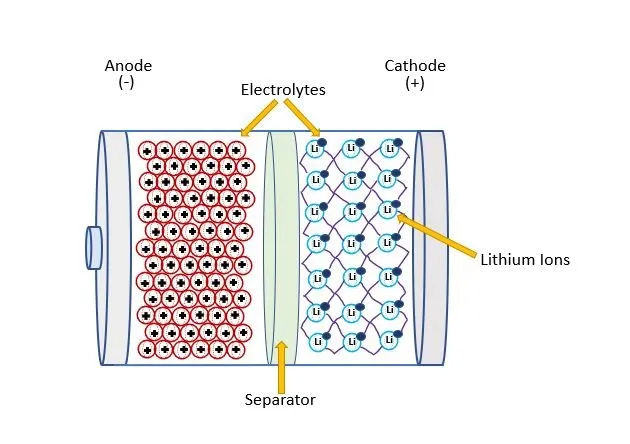
Figure 1: Lithium‐based battery cell diagram with four main components: a cathode, an anode, a separator, and an electrolyte liquid.
Thermal runaway occurs when heat generated from the battery escapes the cell. The separator melts and allows the anode and cathode to mix. When they react, they cause the temperature of the battery to dramatically increase. This phenomenon can ignite the flammable electrolyte solution and cause a fire or other potentially violent reactions. Below are some causes of thermal runaway:
- Internal short circuit caused by cells made with poor quality material.
- Overcharging of batteries.
- High or low temperature environments.
Commercial
- Lithium‐based batteries can store a large amount of energy in a small containment unit.
- Batteries are designed to be used in a specific manner, deviations from this can be dangerous.
- Like any consumer product, defects can be found in a small number of these batteries leading to overheating, fire, or explosion.
Lab‐fabricated
- Lab fabricated batteries face the same hazards as commercial batteries. However, since they are built in house for research, they may lack the safety tests usually done by battery companies.
- Potential exposure to the raw ingredients of a battery. (i.e., Lithium metal, electrolytes, etc.)
Follow manufacturers’ recommendations to ensure battery safety is prioritized.
Purchasing
Purchase batteries and battery‐powered devices from reputable manufacturers; high quality rechargeable devices can be easily distinguished by a UL (Underwriters Laboratories) or ETL (Electrical Testing Laboratories) label. This demarcation states the battery or device has been safety tested and will perform as expected compared to non‐UL or non‐ETL products.
Storage
Store batteries and battery‐powered devices at room temperature and out of direct sunlight. Store batteries and battery‐powered devices away from open flames and combustible materials. Do not store batteries in metal containers. Provide physical separation of batteries from conductive materials, including from metals or other batteries, as this can lead to a short circuit. Do not expose batteries to extreme temperatures. For those in research, consider storing your batteries in a fireproof casing when not in use or when in transport.
Charging
Charge batteries and battery‐containing devices only in accordance with manufacturers’ instructions. All chargers should bear the UL or ETL mark; never use third party chargers as they may cause the system to overheat because of overvoltage. Never leave batteries or devices charging unattended; ensure they are charging in a safe location (e.g., never charge on or near combustible materials). Never use charging as a storage method. Always allow batteries to cool before using, after charging and before charging, and after using.
Reminder! “Fleet charging” of multiple e‐scooter or e‐bike batteries is NOT permitted inside any Columbia University campus or residential building or on Columbia University property.
Transportation
Handle batteries with care when transporting and consider transporting in a heat‐resistant and fireproof case. Do not transport batteries in metal containers.
Please contact [email protected] for information about shipping batteries.
Lithium-ion Battery Safety Advisory:
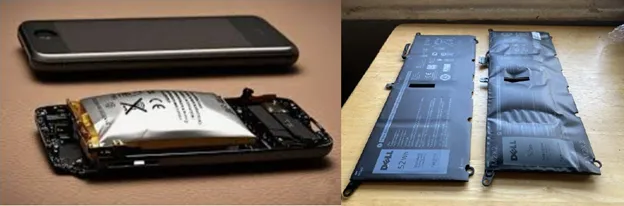
Discontinue use immediately if a battery or device appears to be overheating, bulging, changing color, leaking, or emitting a strange odor or sound. These are signs of thermal runaway, a potentially hazardous condition where gases released may be flammable and toxic.
Undamaged Lithium-ion Battery Disposal
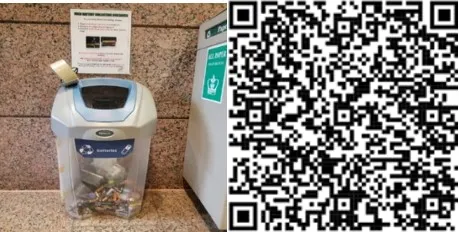
- Undamaged small batteries should be placed in one of the many specific batteries recycling bins found on campus (Scan QR code for locations).
- Prior to recycling, place clear tape on battery terminals to prevent contact with another terminal in order to prevent a short circuit.
- Damaged, corroded, or disassembled batteries cannot be recycled and must be handled as hazardous waste.
Damaged Rechargeable and Lithium - Ion Battery
If the device is a personal item (cellphone, laptop, iPad, etc.) and you are not on campus, please do not attempt to bring the device to campus or transport it via public transportation.
If the device shows any warning signs including physical bulging or expansion, excessive heat, visible signs of leakage or residue, etc.:
- Turn it off, unplug it, and discontinue use immediately, if safe to do so. Do NOT attempt to charge the battery.
Dispose of it properly by:
a) Taking it to a Special Waste Disposal site in your area
- https://www.nyc.gov/site/dsny/what-we-do/programs/special-waste-drop-off.page
- https://www.call2recycle.org/locator/
- Call 311 or go to https://portal.311.nyc.gov/article/?kanumber=KA-02078
b) Dropping it off at a store that sells rechargeable batteries or electronics—many locations offer battery recycling programs.
Columbia Property on Campus
If the affected battery or device is Columbia property and/or the device is located on campus, and it is safe to do so:
- Turn it off, unplug it, and discontinue use immediately, if safe to do so. Do NOT attempt to charge the battery.
- Place the battery in a chemical fume hood, away from any flammable materials.
- If a fume hood is not accessible, move the device to a safe location and keep it away from people, paperwork, and other combustible materials.
- If the battery is in a device and the device is on, please turn it off (if possible).
- Immediately contact EH&S
In the case that a battery is smoking or has ignited: Call Public Safety!
They will alert the fire department and assist in evacuation efforts if necessary.
Columbia University Public Safety
- Morningside: 212-854-5555 (emergency calls)
- Manhattanville: 212-853-3333 (emergency calls)
- Medical Center: 212-305-7979 (emergency calls)
- Lamont Campus: 845-365-8555 (emergency calls)
Follow hazardous waste procedures for disposal of fabricated batteries in research.
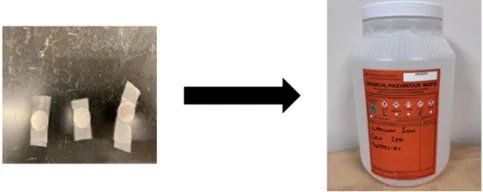
- Intact Coin/Button Batteries:
- Tape terminals or individually wrap batteries to prevent short circuiting
- Collect in a container with an orange hazardous waste label labeled “coin/button cells” and specify the materials used
- Example:
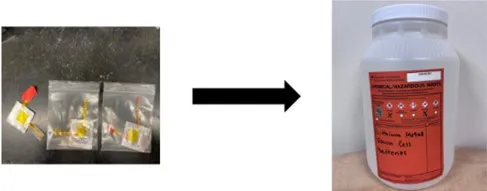
- Intact Pouch Batteries:
- Tape terminals or individually wrap batteries to prevent short circuiting
- Collect in a container with an orange hazardous waste label labeled “pouch cells” and list the electrolyte contained in the cell and any other constituents
- Do not mix with other types of batteries
- Example:
- Opened / Not Intact Batteries:
- Submerge all exposed battery components in clean mineral oil
- Lithium Metal:
- Submerge in clean mineral oil before removing it from the glove box
- Collect in a container with an orange hazardous waste label labeled
“lithium metal in mineral oil”
- Bulging Batteries:
- Bulging batteries pose a significant health and safety risk
- If a fabricated battery is damaged, safely place the battery in a labeled waste container and move it under a chemical fume hood. Call EH&S immediately at 212-854-8749