

Electrical Safety
This page provides information on electrical safety, highlighting essential practices for working with electrical systems. It covers basic electrical safety, handling high voltage electricity, and using specialized equipment. Additionally, it addresses electrical safety in laboratories, offers training resources, and outlines emergency response procedures. Understanding these topics is vital to preventing accidents and ensuring a safe working environment when dealing with electrical hazards.
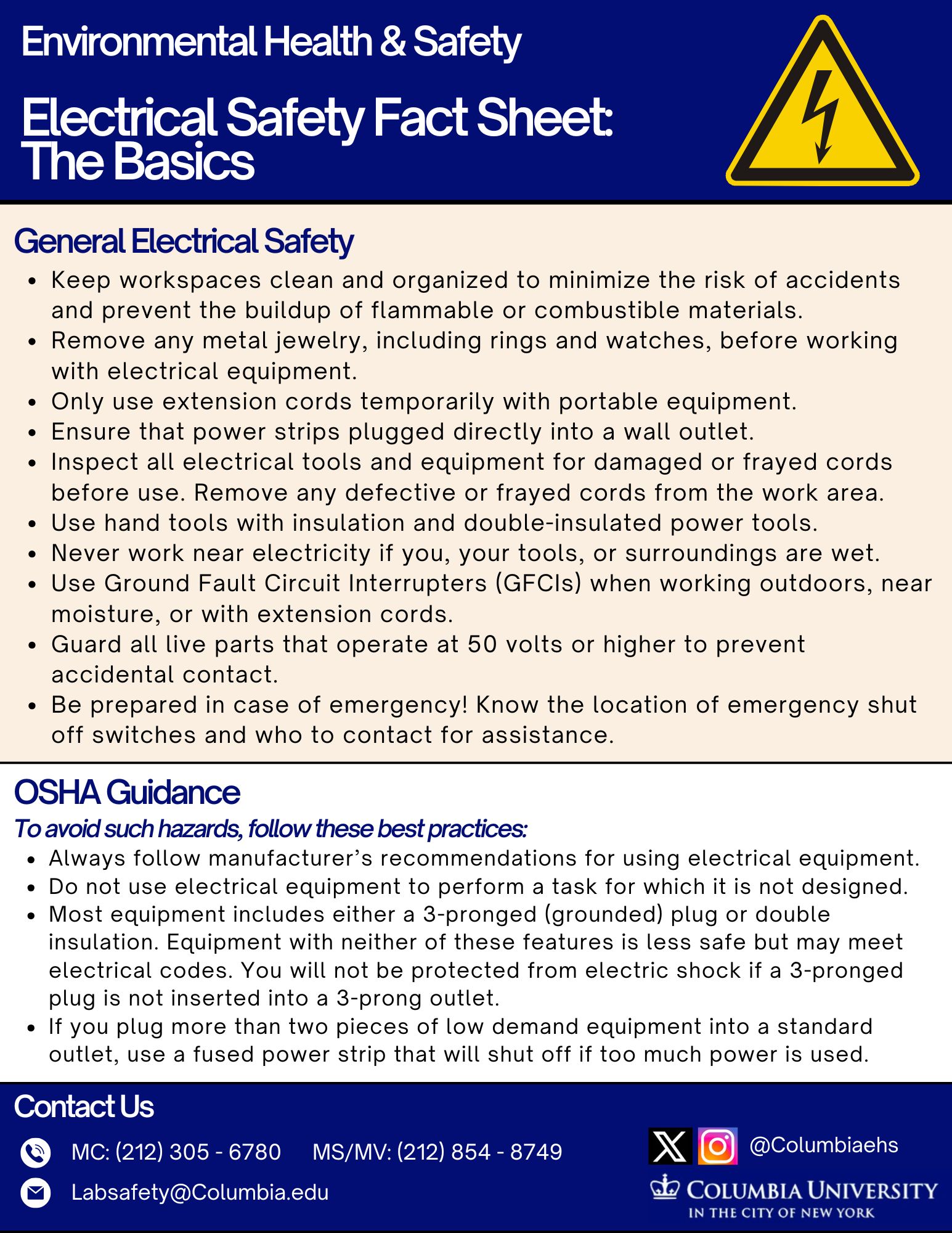
General Electrical Equipment Guidance
- DO NOT manipulate or work on equipment while it is powered on. DO NOT attempt maintenance on equipment while powered on.
- Use modern equipment in good condition.
- Follow manufacturers’ guidance on how to operate and maintain equipment.
- Create a regular schedule for maintenance following manufacturers guidance.
- Use equipment for its intended purpose and keep all safety shields and covers in place during operation.
- Ensure that the equipment has adequate cooling systems if necessary and it is functioning properly.
Electrical Hazards from Common Lab Equipment
1) Electrical Hazards from Battery-powered Equipment
Examples: Portable pH meters, handheld spectrometers, rechargeable thermometers, and portable pumps.
Potential Hazards: Electrical shock, short circuit, and battery leakage.
Safety Tips:
- Inspect batteries and charging stations regularly for damage, leaks, or corrosion, and replace faulty batteries immediately.
2) Electrical Hazards from Heating Equipment
Examples: Heating mantles, drying ovens, incubators
Potential Hazards: Short circuiting, overheating, and burns.
Safety Tips
- Regularly inspect heating elements, power cords, and insulation for signs of wear or overheating to prevent electrical shock or fire.
- Use the equipment in well-ventilated areas to avoid heat buildup, leading to electrical malfunctions.
- Do not use equipment longer than the recommended duty cycle.
3) Electrical Hazards from Light-Generating Equipment
Examples: Microscopes with built-in illumination, gel documentation systems, UV lamps, and fluorescence systems.
Potential Hazards: Exposure to high voltage, electrical shocks, and short circuiting.
Safety Tips:
- Inspect bulbs and light sources for cracks or signs of damage before use to avoid electrical failure or fire hazards.
- Avoid contact with light-generating components when in use, especially high-intensity light sources, to prevent electrical shocks or burns
4) Electrical Hazards from Spinning Equipment
Examples: Centrifuges, vortex mixers, and laboratory shakers
Potential Hazards: Motor malfunctions or failures, imbalances, worn slip rings and brushes, and overheating.
Safety Tips:
- Always ensure that centrifuge tubes are properly balanced and securely fastened to prevent electrical and mechanical failure.
- Do not open equipment while it is spinning, as it may expose electrical components to harm.
- Regularly inspect spinning equipment for any irregularities, such as excessive vibration or unusual noises. If equipment starts to exhibit these during cycle immediately turn off equipment.
5) Electrical Hazards in Wet or Moist Conditions
Examples: Water baths, incubators, autoclaves, and sonicators.
Potential Hazards: Electrical shock, short circuits, overloaded circuits, inadequate grounding, and corrosion of electrical components
Safety Tips:
- Make sure that electrical outlets and connections are Ground Fault Circuit Interrupter (GFCI) protected when working near water sources.
- Use moisture-resistant covers on electrical components of wet equipment to prevent short circuits or shock hazards.
- Always keep cords and plugs dry. Immediately disconnect equipment from power sources if they contact water.
6) Electrical Hazards from Electrophoresis Equipment
Examples: Electrophoresis power supplies, gel electrophoresis apparatus, and DNA sequencers
Potential Hazards: Corrosion of electrodes and wires, exposure to unprotected electrical contacts, and contamination from electrical failure.
Safety Tips:
- Check that power supplies are turned off before connecting or disconnecting electrodes or sample trays to avoid shock hazards.
- When working with gel or electrophoresis tanks, check that all connections are secure and insulated to minimize the risk of short circuits or electrical hazards.
Basic electrical safety concepts are incorporated into both TC4951 – Lab Safety, Chemical Hygiene, Hazardous Waste Management, and Fire Safety Initial Training and TC0950 – Lab Safety Refresher to ensure that all laboratory personnel receive foundational awareness as part of their core safety training. For groups who work more directly with electrical hazards or would like more in-depth guidance, EH&S offers TC7913 – Electrical Safety: Basic Best Practices for the Laboratory, which focuses specifically on electrical hazard recognition, risk reduction, and safe work practices.