
Compressed Gas Safety Program
Compressed gases are materials or mixtures that exert a pressure of 280 kPa (40.6 psia) or higher at 20°C in their packaging. This includes compressed gas cylinders as well as cryogenic materials, such as liquid nitrogen. The primary hazard is the potential energy from high pressure, but they can also pose additional risks such as flammability, toxicity, corrosivity, reactivity, cryogenic, and asphyxiation hazards.
The responsibility for safe use lies with the principal investigator (PI) and their department, while researchers must follow safety protocols, including using engineering controls and wearing the proper personal protective equipment (PPE).
At Columbia University, handling, storage, and disposal of compressed gas cylinders are regulated by agencies like NFPA, OSHA, EPA, USDOT, and FDNY. EH&S has developed a Compressed Gas Safety Manual to assist researchers to be able to understand and follow safety regulations while working with compressed gases.
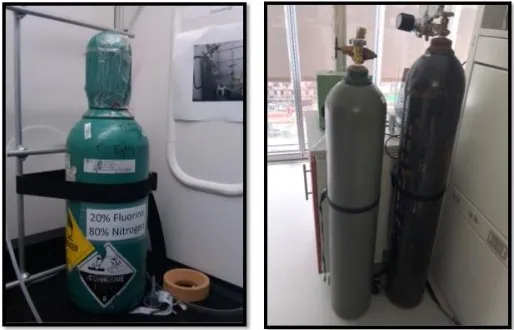
In addition to the routine training already required of researchers, (see Training Finder) users of compressed gases at Columbia University are also required to complete the “Compressed Gas Safety Training” RASCAL course TC5450 before starting any relevant work.
For laboratories working with liquid nitrogen, a liquid nitrogen dewar transfer training is also available, RASCAL course TC7700 CU Liquid Nitrogen Transfer Training.
EH&S has developed a Compressed Gas Safety Manual to assist researchers to be able to understand and follow safety regulations while working with compressed gases. Highlights include the following attachments:
-
Summary Table of Compressed Gas Hazards lists a number of commonly used hazardous compressed gases at the University and is a good resource for researchers to consult in order to understand the specific hazards associated with the gases they are using.
-
Laboratory Requirements for Hazardous Gases provides information regarding the necessary rules and regulations to follow while working with gases that belong to specific hazard classes. This includes information about labeling, signage, storage, handling/moving, ventilation and monitoring requirements for gases that exhibit specific hazards such as flammability, reactivity, toxicity, oxidizing properties etc, along with regular compressed gas cylinders.
Vendor Questionnaire for Gas Detection Systems provides information regarding the selection of vendors that can provide gas detection equipment.
- “The basics of cylinder handling” video from Matheson has helpful tips regarding the handling, stabilization and transportation of compressed gas cylinders.
- How To Connect A Gas Cylinder
- How To Connect A Liquid Nitrogen Dewar
- How To Disconnect A Gas Cylinder
- Liquid Nitrogen Transfer Video
Some additional technical resources available electronically or through request by EH&S:
-
Matheson Gas Data Book (hard copy), Matheson Gas Products
-
NIOSH (electronic) Pocket Guide to Chemical Hazards
-
The NIOSH Compressed Gas Self-Inspection Checklist
Columbia University Facilities should be contacted if any assistance or services, such as the installation of cylinder securing equipment, is required.
-
Morningside campus: Please submit a request through the Facilities webpage https://facilities.columbia.edu/request-service/overview
-
Irving Medical Center campus: Please use the “Submit a Work Order” link found on the Facilities webpage https://www.cumc.columbia.edu/facilities-management/facilities-services.
-
Manhattanville campus: Please call 212-853-3333 to request service.
-
LDEO campus: Please call 845-359-2900 and ask for the Safety Office.
-
Nevis campus: Please contact Peter Macaluso ([email protected]) with requests.